Author:
• Friday, April 03rd, 2026

Let’s say you want to hold a wide piece of wood in a classic front vice of the workbench. You probably do not want to grip it in the middle area of the vice because it must be held above the lead screw and guide rod. 

You can grip the wood by the part of the jaw that is fully to the right of the screw and rod. This allows the wood to be lowered to where you want it. It will be held at a much better working height for planing and other tasks. (Exactly what is done with the right end of the wood itself will be discussed in a latter post.)                           

But the problem now comes when the vice is tightened. The empty left side of the moveable vice jaw can curve toward the bench top. This especially happens when strongly gripping thick pieces of wood. When the vise is turned tighter, it actually reduces the area of the pressure contact against the workpiece. (All of this varies with differently constructed vice designs in different benches.) 

Solution? Yes. Easy!

You just put an approximately matching thickness piece of wood in the left side of the jaw. This distributes the tightening pressure against the bench from the right and left ends of the vice. The vice stays aligned and, most importantly, the work wood is gripped more securely and evenly.  

You do not have to hold the matching piece there when tightening the vice. A wide cross piece grips it with a magnet and keeps it there. (See photo above.) So you place it, let it go, and then place in the work piece on the right side of the vice at whatever height you want. 

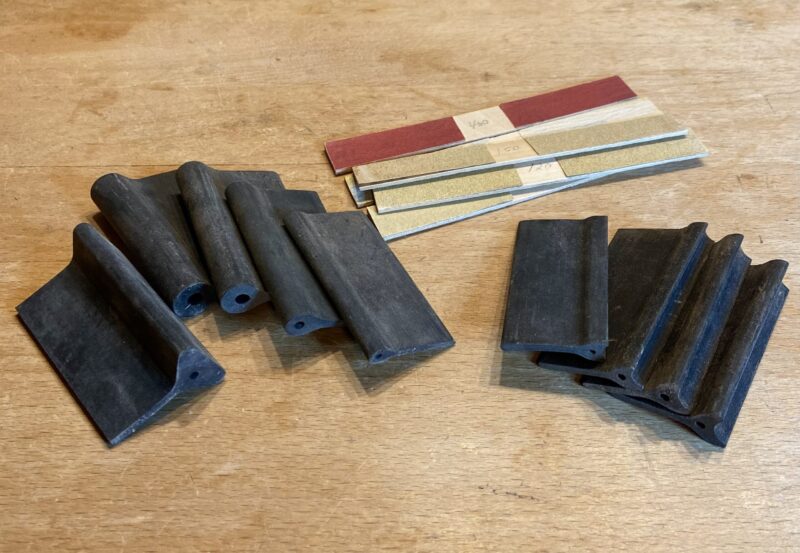
I have a small collection of gripper pieces, from 3/8” through 1” in 1/16” intervals, and 1 1/8” through 1 3/8” in 1/8” intervals. That is 14 sizes that covers thicknesses within 1/32” of most work pieces. Close enough to work.

They are 3” long with a flat head screw in one end to grip the holder top piece. The holder is 5” x 1” x 3/8” with a 3/4” diameter magnet at the center. The grippers get stored in the bench drawer, and the holder gets stored at the head of a flat screw leveled into the side of workbench. 

This is very easy to make and use. It really improves the performance of the bench vise.

But what do you do with the right side of that long workpiece which has its left side securely in the front vice? 

Answers in the next two posts coming up! 

Author:
• Tuesday, March 31st, 2026

We often use the outer edges of the top of our workbench to restrict any movement of a piece of wood being worked on. Let’s go through some handy, practical methods to keep the wood in place. These can all be easily made by you with minimal cost.

The first one is very simple. Sometimes we have a board, thick or thin, that we do not want to clamp down. We just want to stop it from sliding in one direction – for most people, to the left.

On the left side of my bench, I have two small blockers that can be quickly and easily raised for this purpose. The photo above shows an example of a piece of beautiful cherry in place. The blockers never get in the way when not in use. They have been part of my bench for a long time.

Here is how I made them: 

The hardwood pieces are 1/2” thick x 2 1/2” long x 1 1/2” wide. They have a 1/4” wide slot, about 1 3/4” long from the bottom. The main, visible screws have large handles, 1 1/2” in diameter (“star knob heads”), to make them very easy to use. They are 1/4” – 20, 1” long. These are very easy to loosen and tighten.

Those handled screws go into slotted set screws. The set screws sit very firmly in their drilled and slightly taped holes. These are centered about 1” from the top surface of the bench and about 6 1/2” apart. 

We’re all done. This little rig can be used for lots of tasks. 

Another nifty tool is coming up in the part 2 post.

Author:
• Saturday, March 21st, 2026

Only you know, but here are some of my thoughts. 

You are taking a break from work, family, wood shop, and the duties of life to spend a few minutes enjoying and adding to your woodworking. Let’s go over what is here.

Since 2008 I have published here 264,000 words written originally by me alone. (Not including comments.) That is the length of four non-fiction books! There are over 1400 original photos taken by me. 

It is all real and all directly from my wood shop. The only break in publishing was about two years, which you can read about here:

https://www.rpwoodwork.com/blog/2025/07/03/where-was-i/

The site remains quite popular and well regarded among the valid online evaluation systems.

I simply want to share my woodworking with you so you can enjoy and add to your work in the shop. 

There are never advertisements here. No business or selling for me or anyone else. I do not make a dime here. And that is just fine. No nonsense. No time wasting. 

There is also periodic philosophic thought for real woodworkers – like you. I have been woodworking for over 60 years, always growing in skill. So yes, I do have something to say!

I also aim to getting you thinking and evaluating your work. I would love to know that you are making things, but even more, I truly hope that you are happy doing it. 

THANK YOU, dear readers! More to come! 

Category: Ideas  | 4 Comments
Author:
• Thursday, March 12th, 2026

Now things get more tricky. If you have been avoiding angled joints, or maybe you tried and messed up a few (hey, I think that is everyone who has tried them) I want to put them in general categories with different levels of potential difficulty.

This is not to show detailed, step-by-step processes. Rather, I just want state the general ideas from which you can develop your specific methods. 

So let’s start with the easy group. This is where the joint angle goes across the width of one or both pieces. The length of the piece is simply cut at an angle, ideally on an accurate table saw crosscut jig. 

The photos below show two examples. One is a piece with a 90° edge matched with a piece with an angled edge. The other is a pair of pieces that each have an angled edge.

No problem. These can go directly to your dowel jig, Domino, or mortising jig. Plan the position and length of the holes or mortises. They are cut at 90° to the angled edge of each piece.

Now it gets harder. The angle is at the edge of the thickness of one or both pieces, placed at the end of the length of the piece(s).

The photo at the top of this post shows the angled edge of each of two pieces. The angled piece can be joined to another angled edge or simply to a flat edge.  

The first photo below shows a pair of angled end-grain edges across the flat width of each piece. 

The next photo below is to imitate a chair joint. (To make the photo of the unassembled pieces easier, I placed the “chair” upside down.) The angled-end piece, at 2°, meets the long grain of the “chair leg”.

These are examples of where things get trickier to make. Why? Because we have to join the angled edge to a flat surface. The flat surface can simply be square to the board as in the two photos below, or can be an angled flat surface of the other piece. The joint cutter must be at the angle of the angled piece(s).

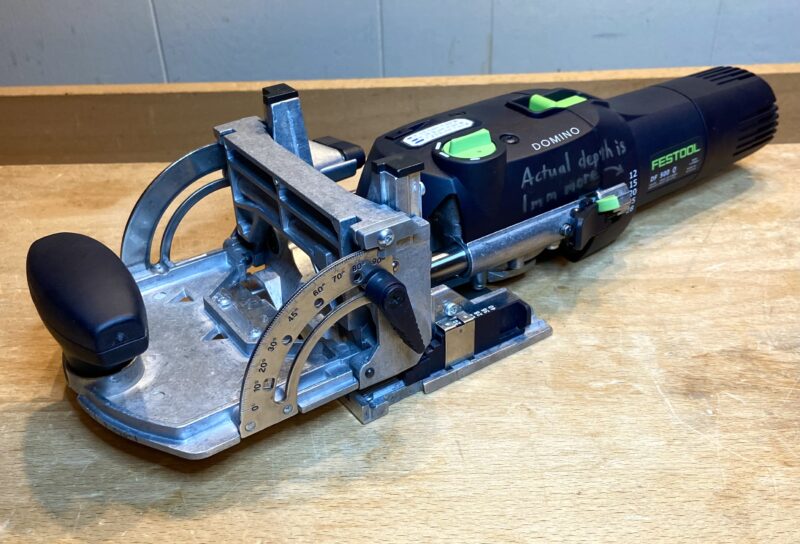
For this job, there are many options. Domino can work well, though there must be good placement and grip of the machine. Any angle can be set. DowelMax makes a doweling jig, though it works at only 45°, which will build a box or similar items. The Leigh FMT and Woodpecker MultiRouter (both are expensive, as are Dominos) can do a really nice job. I suggest making a pair of mortises and a free tenon for an easier job. The Leigh FMT works well for me for this task. It is precise and reliable. The PantoRouter looks like it also could certainly do the job. 

JessEm has a Doweling Jig Workstation. I have not used it but I was not impressed by what I saw online, along with the related (?) Pocket Mill Pro. There is also many other machines that can do this task, many high priced, which I am not familiar with.    

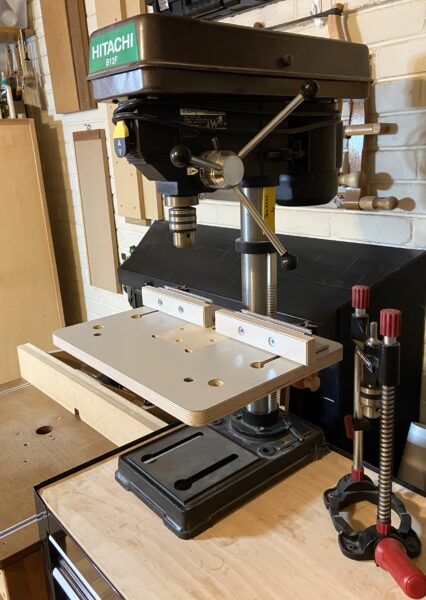
What about angling a conventional drill press? Yea, maybe, but getting perfect, steady angles that give good joint matchup is difficult. Not my choice. I also suppose something could be worked out with a benchtop mortiser, but I have never been a fan or owned one of those. 

With all of this, remember that you are cutting square to the joint surface of the angled piece(s) and the square-edge of the other part of the joint if that is how it is set up. 

With good equipment and planing, we can reliably make these joints!

Now, there is one more problem. Though I have done it in building, I have to say it is difficult. This is when a part of the joint is curved AND has an angled edge. With a tenon, or a mortise and a loose tenon, it meets a flat surface. The photo below shows an example. 

Sometimes, this can be done when the wood has not yet been curved on its main surface, but not always. Sometimes handwork is the best and fastest way. It does take careful work!

Well, we’ve done it! We have covered a full range of joinery that I have labelled as “end to side-edge joinery.” Again, the idea of all of this is to organize the workable, practical systems and tools that allow you to choose how you can comfortably and effectively guide your woodwork. I think that the age of the traditional mortise and tenon is largely over for most woodworkers.

I hope it helps!

Category: Techniques  | Leave a Comment
Author:
• Friday, March 06th, 2026

Is this a strong joint? No. Useful? Yes. It is helpful where connection is otherwise awkward and high strength is not needed. 

It does not make the show for looks either. Yet sometimes that is no factor at all because it lives unseen.

A veneer table top is a nice example. Screw the top to the side braces below. Unless the table is dragged around with heavy weight on it, and as long as the veneer is bound to a largely unchangeable base like MDF, it will be fine. If the table top is regular, jointed wood, it can be screwed at central points on the sides, or on one side, while the remainder has, for example, the slotted L joints that allow seasonal movement. 

It is really just another example of keeping your arsenal in mind. Me? Yea, I screwed in place one spot of a small table top with two long holes and screws. Well, it worked, but if you get underneath the table, you can find my sloppy work. Sure, the owner and no one else will care or probably ever see it. But that was a lousy part of an otherwise nicely made table. Why? Because it did not step back and review my options, including what sat on a shelf a few feet away from me.

This is the key to this series of posts: Know, understand, and consider your viable building and joint options to make the project as well as you really want to, with the most viable and practical construction options.   

I find the best tool for the kind of screw joint covered here is the Kreg. It allows the slanted hole to be drilled accurately and steadily. The screw is also easy to drive in. It is too easy to go wrong without this help.

This post shows the simple version that covers my needs. Kreg has much more elaborate models. I am also showing the small #7 1-1/4” finely threaded screw. Much thicker, longer, and coarsely threaded screw systems are available. I still do not consider these a very strong joint but, again, it is a very nifty system to meet the strength and looks needs for the situation. 

Well, there is only one more topic – a tricky one –  to cover the “end to side-edge joinery” in this long series. That is: ANGLES! Various sorts – some easy, some tricky. Coming next. 

Category: Techniques  | 4 Comments
Author:
• Tuesday, March 03rd, 2026

The biscuit joiner just slightly makes the list of techniques for edge to side-edge joinery. It is not a strong or deep joint but it is easy to do. It does have a useful role.

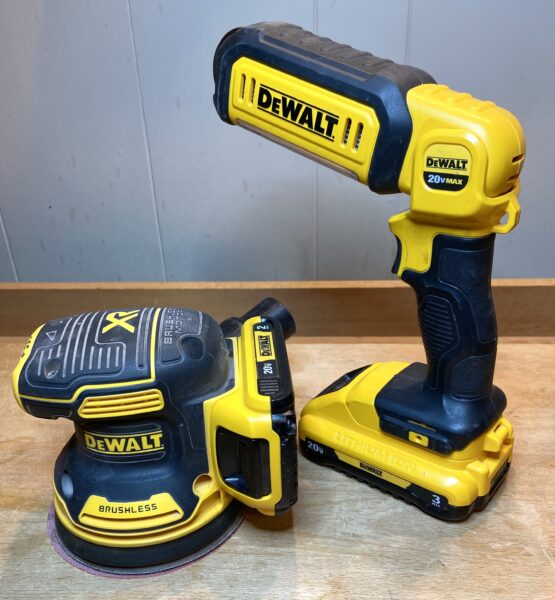
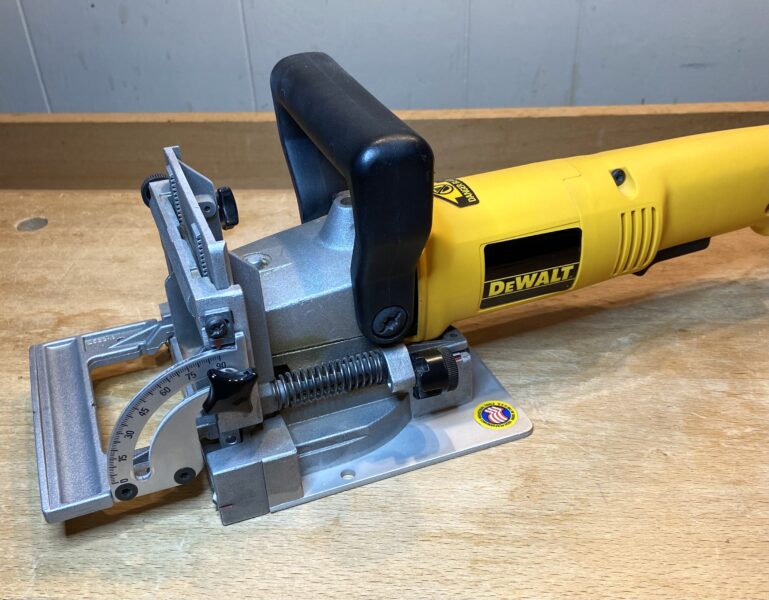
A machine for this can cost less than a $100 if you dare, $250 for a good DeWalt, or a thousand or two for Lamello exotics. I have had a DeWalt for many years without failure. It is handy to have the dust collection attachment. Now, niftier than my old DeWalt is their brushless, cordless version.

Wood biscuits that range in size from small to large (#0, #10, and #20) cover all work for me. The biscuits are only 5/32” thick. They fit snugly into the slots. I have never tried the plastic versions. 

I have used biscuits for light weight, small, thin shelves and side pieces. I would not rely on them for frame strength or any other real strength issue. 

The handiest role for biscuits is edge-to-edge joinery. That is, joining flat boards together to make a bigger flat board. Once you have flattened the pieces to thickness and planed the edges to produce the joints, it is invaluable to keep the thicknesses perfectly aligned. This saves you from a lot of unpleasant planing! 

So, for the end to side-edge joinery that I am discussing in this series of posts, biscuits are not a core item. Still, the biscuit joiner is certainly worth having in the shop for most woodworkers.

Next: we’ll discuss screws. What you say? Screws for real woodworking? Yes, they have a role!

Category: Techniques  | 2 Comments
Author:
• Monday, March 02nd, 2026

This is a short post to summarize the glue joint distribution of dowel joinery that was discussed in detail in the last post and with excellent commentary from readers. 

Dowel joinery, properly done with good dowel layout and distribution is certainly strong enough. This has been well shown online, notably by DowelMax testing. Some, certainly not all, of the other testing shown online is invalid in my opinion.

Realistically, it is the portion of the joint where the attachment pieces (dowels or tenons) go across the grain of one of the two main components of the build where there is the potential for breaking apart. Yet this does not lead to broken joints if the sizing is properly done.

Dowel joinery creates different cross-grain conflict than mortise-and-tenon joinery. Some of the dowel meets the cross-grain of the built wood, but some of the dowel meets the end grain of the built wood. This makes it seem weaker, especially over time. However, the overall result still fares very well.

Dowel style – parallel or curled groves – probably matters little if at all.

The main credits for dowel joinery, in my view, are: 1) Decades of dowel joints that I built have never failed. There is plenty of building where I have not used them. Probably because I do not fully trust them in some situations.  2) Valid mechanical testing shows that dowel joinery meets or exceeds mortise and tenon joinery. 

So, after thinking through dowel joinery over and over, in numerous ways, it just cannot impress me. However, it works! Shown and proved. So I use it. Not always, but often.  

Next: Other ways to join wood. We are building to a summary of practical, convenient joinery to build things with. We’re getting there. 

Category: Techniques  | 2 Comments
Author:
• Saturday, February 07th, 2026

Consider the strength of the end to side-edge joinery which we have put into three categories: mortise pair and free tenon, Domino, and dowel. 

When did you see a properly made joint fall? I never have in my work. The dowel joint gets the most criticism regarding strength. Let’s discuss that.

As an example, consider a 2 3/8” dowel joint with three 3/8” dowels that are set 3/8” apart and 1/4” from the edges. (As above photo.) We only need to examine the cross grain part of the joint. The other half – dowel grain entirely inline with the wood grain – will really not break for practical reason. 

Based on the number of dowels and their diameters, the total glue width is 3.5”. As a mortise joint, we are gluing 3.9” width. This assumes not applying glue to flat or curved outer tenon edges to allow space for a bit of seasonal movement. Nor would the bond grip well there. We also assume the depth of the joint is the same for dowel and mortise. 

Also, note that some of the dowel side area, though entirely glued, does not grip as well since it is attached to opposite grain direction. It is hard to say at what stage of the circle this changes for better.

So, the dowels use a little less glue joint area than mortise joints, but not much. Working out a similar example using 1/2” dowels in a 2 1/2” wide joint, gives 4.7” of glue width. The mortise joint has less at 4” of width. 

By the way, wedged tenons – either at the central end or on the sawn and angled wide sides – have a distinct strength advantage. For that we have to award the strength contest to mortise and tenon.  

Basically, to compare mortise and tenon joints with properly made dowel joints is a close call for strength in my opinion. 

The best joint strength contests that I have seen online are done by the DowelMax. They look careful and legitimate. Dowel joints win. Dominos come in third place.  

All of this is not a science project. I simply am saying that joint strength is not a good reason to oppose dowel joinery. Again, it must be properly done, like all joinery. 

Let’s give the appropriate, but commonly opposed credit to dowel joinery: strength. It also is convenient, fast, and cost efficient for good tools. Pieces that I have made months ago as well as decades ago with plenty of dowel joinery have never failed!

Once again, I list the three main joints I use and recommend for woodworking: Pair of mortises with free tenon, Domino, Dowels. 

But which of the three have I now come to choose most of the time? The answer is coming but anyway, my choice may not be your best choice. 

Having a realistic practical choice is what matters for each woodworker. Hopefully this series helps you choose. 

More to come.

Category: Techniques  | 10 Comments